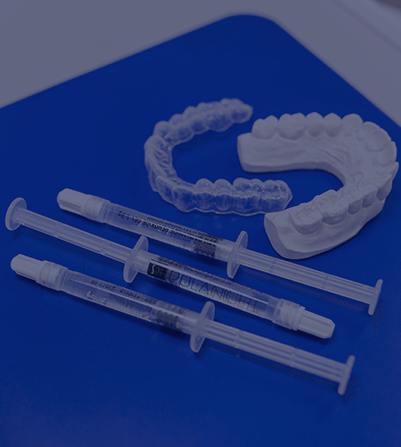
Teeth whitening from a dentist here at Chase Side Dental involves using a bleaching kit at home with trays made to fit your teeth. Here is what to expect during teeth whitening with us. Before you begin, we examine your teeth and gums to check that whitening is suitable for you. Once you start, we guide you on using the trays, and we check how your teeth are responding as your treatment progresses.
Teeth bleaching is another term for teeth whitening with peroxide, so you will see both words used here. The gel helps break down stains, but it can irritate your gums if it is not used correctly. That is why we explain how to apply the gel and what to do if your teeth become sensitive, and we ask you to follow our instructions and the manufacturer’s instructions for wearing the trays.
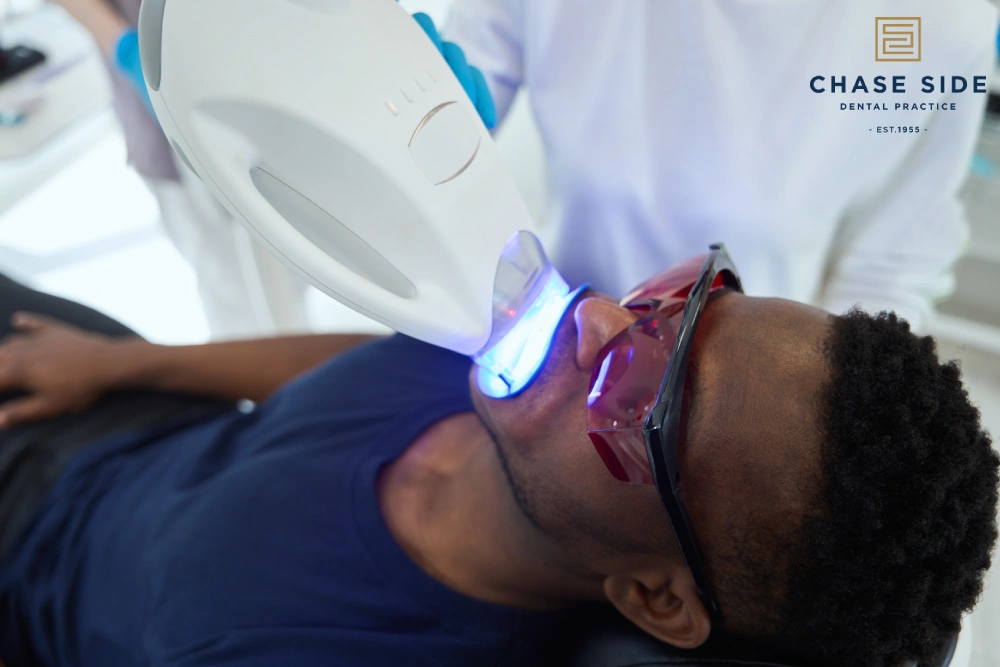
Dentists bleach teeth with a peroxide gel, and the teeth bleaching procedure here at Chase Side Dental involves three stages. Your appointments for teeth whitening at the dentist cover the checks, your trays and your reviews, and the bleaching itself happens at home.
The checks we make before the teeth whitening process begins are explained below.
Before we start whitening, we check your back teeth for decay, and we take digital X-rays where they are needed to see decay hidden between the teeth. These use a low dose of radiation. Decay needs treating first, because whitening gel that reaches an untreated cavity can cause sharp sensitivity.
If one front tooth looks darker than the others, we find out why before whitening begins. An injury, such as a fall or a knock to the mouth, can damage the nerve inside a tooth, and if the nerve dies, the tooth slowly turns darker. We may take an X-ray and carry out tests to check that the nerve is healthy. These checks tell us if whitening is the right treatment for that tooth, and if it is not, we explain what the tooth needs instead.
If you have had sensitive teeth before, we plan for that before your teeth whitening starts, because the gel can make existing sensitivity feel stronger. For that reason, we choose a lower concentration of bleaching gel for your trays, which is gentler on sensitive teeth.
We also suggest brushing for at least two weeks before you start your teeth whitening with a sensitive toothpaste that lists potassium nitrate in its ingredients. Potassium nitrate helps reduce the response of the nerves inside your teeth to triggers such as cold drinks. Using it regularly before treatment can make sensitivity easier to manage once you begin wearing your bleaching trays.
It is not advisable to bleach your teeth if you smoke, because smoking darkens teeth anyway and can reduce the effect of the bleaching. For that reason, it is best to stop smoking for at least three weeks before you start.
Tooth-coloured (composite) fillings in your front teeth are matched to the shade of your teeth as they are before you bleach them, so they may not match afterwards. This is because your teeth lighten but the fillings do not, so a filling that matched before can look darker than the tooth beside it. Once you have the colour you wanted, we can replace these fillings with a lighter shade to match your new tooth colour, and we normally wait two to three weeks first so that your new shade has settled.
Crowns and veneers do not whiten either. If you want them to match your natural teeth after whitening, you may need them replaced once the whitening is complete. We will talk you through any costs for this before you start.
Book your whitening assessment
Teeth whitening, also called teeth bleaching, works by using a peroxide gel to lighten the stains inside your teeth. The active ingredient in the gel is either carbamide peroxide or hydrogen peroxide, and it starts working once your tray holds the gel against your teeth.
If the active ingredient is hydrogen peroxide, it starts to break down as soon as it touches your teeth. If it is carbamide peroxide, there is one extra step, because the moisture in your saliva helps split it into hydrogen peroxide. That extra step makes it slower, which is why carbamide peroxide is used in trays that stay on your teeth for longer.
From there, both follow the same path. The hydrogen peroxide breaks down and releases reactive oxygen, which is oxygen that reacts easily with other molecules. It passes into the enamel, which is the hard outer layer of your tooth, and then into the dentine beneath, which is the yellower layer that gives a tooth much of its colour. Inside both layers, it reacts with the coloured molecules and breaks them down, so the stains look lighter.
Because the stains sit within the tooth and not only on its surface, brushing cannot lift them in the same way. How much lighter your teeth become depends on their original shade and the cause of the stain, which is why we examine your teeth first.
Dentists describe the colour of teeth using a shade guide, which is a set of sample tabs held up against the teeth for comparison. Each shade is a letter and a number. The letter shows the colour family, with A being reddish brown, B reddish yellow, C greyish and D reddish grey, and the number shows how strong the colour is, so a higher number means a stronger colour within that family.
From lightest to darkest, the shades run B1, A1, B2, D2, A2, C1, C2, D4, A3, D3, B3, A3.5, B4, C3, A4 and C4. This is a way of describing the colour your teeth start from and the colour they become, and it is not a promise of the shade you will reach, because, as this page explains, results depend on the cause of the stain.
The NHS explains that using a kit from a dentist, or having teeth whitening done at a dental surgery, is the safest way to have your teeth whitened. That is why we check that your teeth and gums are suitable before you start and give you instructions for using your kit. The bleaching gel we use also has a pH close to neutral, so it is not strongly acidic.
Dentists have been using peroxide whitening for more than 50 years. Like any treatment, bleaching can cause side effects, including tooth sensitivity and gum irritation if gel is left on the gums. These are usually temporary, and we explain what to do if you experience them on this page.
Over-the-counter and online whitening kits are inexpensive, but the NHS says that kits bought from a pharmacy or online do not work as well as whitening from a dentist and may harm your teeth and gums. The difference between professional whitening and home kits is that we check your teeth and gums first, choose a gel to suit you, and make trays that fit your teeth so the gel stays where it should, which a kit bought off the shelf cannot do.
Teeth bleaching is not suitable for everyone, and for some patients we cannot provide it at all. The NHS says it is not recommended if you are pregnant or breastfeeding, so it is best to wait until you have finished breastfeeding.
We cannot offer teeth bleaching for cosmetic reasons to anyone under 18. The NHS says it is not done for anyone aged 17 or younger, and the law is behind that. Whitening products containing or releasing more than 0.1% hydrogen peroxide can only be provided by a dentist, and cannot be used on anyone under 18 except to treat or prevent disease, as the General Dental Council’s guidance on tooth whitening explains. There is also limited evidence on how safe these products are for younger people. If you are under 18 and unhappy with the colour of your teeth, we are happy to look at them and explain what is causing it.
The gel we usually use is carbamide peroxide in a glycerine base, which is the thick, clear gel that holds the carbamide peroxide in place. If you know of an allergy or a reaction to either ingredient, we cannot bleach your teeth, because the gel sits against your teeth and gums for some time, and an allergic reaction in your mouth could cause soreness or swelling.
Home whitening with custom trays means wearing bleaching trays that your dentist makes to fit your teeth exactly, so the gel stays against your teeth and away from your gums. We give you the gel together with instructions for using it, and the sections below cover how long to wear the trays, what to do if your teeth feel sensitive, and the changes you may notice along the way.
Most patients wear their whitening trays for two to six weeks. Carbamide peroxide gel stays active for up to eight hours, so if we have given you an overnight gel, you leave the gel on while you sleep. If we have given you a daytime gel, you leave it on for a shorter time each day, as we direct.
How long you need overall depends on how light you would like your teeth to become and on the shade they start from. If your teeth are quite dark, or very yellow or grey, bleaching them takes longer. Teeth stained by tetracycline, an antibiotic that can discolour teeth when it is taken while they are developing, can take six to twelve months to lighten. If you are wearing your trays overnight, see our answer on sleeping in your bleaching trays below.
Sensitivity is the most common side effect of home bleaching. It can range from a mild awareness of your teeth to a throb. Some people already have sensitive teeth, particularly near the gum line where the gum has pulled back and left the root surface exposed, and the gel can make that sensitivity more noticeable.
If your teeth feel sensitive, you can stop bleaching for one day, which gives them time to settle. We also suggest placing sensitive toothpaste in your bleaching trays for an hour a day, following our instructions, so it sits against the areas that feel sensitive, and this usually eases it. Alternatively, you can gently rub sensitive toothpaste along the edge of your gums with a clean finger a few times a day for a few days, which treats the spot where you feel it.
If the sensitivity carries on, we may advise you to stop the treatment for a while. Sensitivity from home bleaching is usually temporary and settles once treatment stops. Even so, please call us at Chase Side Dental if you are at all concerned, especially if the pain is sharp or lingers, because we can adjust your trays if needed and check for another cause, such as decay or a crack.
You may notice white spots on your teeth while you are bleaching them, and they can look new. They are usually already there before bleaching, but you did not see them because the teeth around them were darker. As the rest of the tooth becomes lighter, the spots become easier to see, which is why they seem to appear. The aim is to lighten the rest of the tooth around them, and as it becomes lighter, the spots usually become less noticeable. You may spot them straight after a bleaching session, or in the morning if you have worn your trays overnight.
Exposed root surfaces respond less readily to whitening. The root is the part of the tooth that normally sits under the gum, and it shows when the gum has pulled back, so after the top part of the tooth has lightened, the root can look darker by comparison.
Some teeth may also show lighter bands. These bands are usually there already too, but they are hard to see while the tooth is dark. As the tooth becomes lighter, the lighter parts lighten first and the darker banded area follows, so after a week or so the bands usually become less noticeable.
Some patients also have a see-through biting edge on their front teeth, which looks like a bluish halo. After whitening, some teeth look more solid in colour and others look more see-through.
Most patients notice their smile looks brighter as their teeth lighten. It is uncommon for teeth not to lighten at all, but it can happen. If your teeth have not lightened even though you have been wearing your bleaching trays as recommended, we can try a different bleaching product or a slightly higher concentration of the gel. We may also ask you to wear the trays for longer, which gives the gel more time to work on your teeth.
How far your teeth lighten depends on the shade they start from and what stained them, so we can only tell you what to expect once we have examined your teeth. You can arrange that examination here at Chase Side Dental, and then decide whether to go ahead.
Strongly coloured food and drink is best avoided while you are bleaching and for 48 hours after you finish, because the pigments in them can leave stains on your teeth over time, which is one reason teeth gradually become discoloured. Our guide to what stains teeth explains why in more detail. We recommend this as a precaution to protect your new shade, and 48 hours is the window we suggest.
Among drinks, that includes colas, coffee, tea (including green tea), red wine, and cranberry, pomegranate and prune juice. Among foods, it includes curries, beetroot, berries, coloured sweets, and sauces such as mustard, ketchup, soya sauce and red sauces. Tobacco products also stain teeth.
A simple guide is to think about whether a food or drink would stain a white shirt. Your teeth are not the same as fabric, but it is an easy way to recognise foods and drinks with strong colours.
Your teeth normally keep their new white colour quite well. How long it lasts depends on what caused your teeth to discolour in the first place, and on what you drink. Coffee and red wine leave their colour on the surface of your teeth, and cola drinks can add to this, so if you drink a lot of them your teeth may darken slightly.
Keeping your new shade comes down to keeping your teeth clean and your gums healthy. An electric toothbrush is a good place to start, because research has found that powered toothbrushes remove more plaque than manual ones and reduce gum inflammation. Regular professional dental hygiene care adds to that, because it keeps staining to a minimum and shows whether you need a top-up.
Some people prefer to have a top-up every six to twelve months to keep the shade they like, whereas we only recommend a top-up if your shade has dropped. A top-up is a further period of whitening, and recommending it only when it is needed means you do not have extra treatment you do not need.
At home, gently brushing every surface of your teeth helps remove plaque, and gentle is the important word, because brushing too hard can damage your gums and contribute to tooth wear. Flossing removes the debris from between your teeth where a brush cannot reach, and cleaning your tongue keeps your mouth fresh. We will help you choose the products that maintain not only a white smile but a healthy one as well.
One product to leave out is Corsodyl, or any mouthwash containing chlorhexidine, because the NHS says chlorhexidine can stain teeth, which would work against your new shade. The NHS adds that this staining is not permanent and fades once you stop using it, so if a dentist has prescribed it for a reason, it is safest to keep to their advice.
Teeth whitening normally takes two to six weeks from the day you start wearing your trays, after your assessment appointment and once your trays are ready [CONFIRM typical tray turnaround]. How many hours you wear them each day depends on the gel we give you. Your treatment may take longer if your teeth are very dark, if you need to pause because of sensitivity, or if they are stained by tetracycline, an antibiotic that can discolour teeth while they are developing. Tetracycline staining can take six to twelve months to lighten.
Teeth bleaching usually lasts one to three years, and the NHS says the effect may last around three years if you follow your dentist’s advice. How long yours lasts depends on what stained your teeth in the first place, and smoking can shorten it because smoking stains teeth again over time. Bleaching lightens existing stains but does not prevent new ones from forming, so your teeth may gradually become darker again.
Yes, if we have told you that the gel we gave you is suitable for overnight wear, because not every bleaching gel is made to stay on your teeth for that long. Carbamide peroxide gel stays active for up to eight hours, which covers a full night. Gel left on your gums or the roof of your mouth can irritate them, and you would not notice it while asleep, so it is important to wipe away any excess once your trays are in, before you go to sleep.
Teeth whitening in Enfield starts from £375 at Chase Side Dental. Before we recommend treatment, we examine your teeth and gums to check that whitening is right for you, and then we choose a gel to suit your teeth. If whitening is not the right step, we will explain why. To find out what whitening could do for your teeth, book an appointment with us at Chase Side Dental right here in Enfield and we will talk you through your options.
We love our patients
First class treatment and care through out. Many thanks.

I am completely satisfied with the treatment I receive. My dental maintenance is very challenging for you due to my ongoing medical situation. I appreciate the time you take to work out the best option, explain everything to me and then skilfully carry out the agreed procedure.
My family is relatively new to the practice, under the care of Deborah and Luciana, for which we would like to take this opportunity, to complement them on their professionalism, their care and the way they interact with us, which is always friendly and informative.